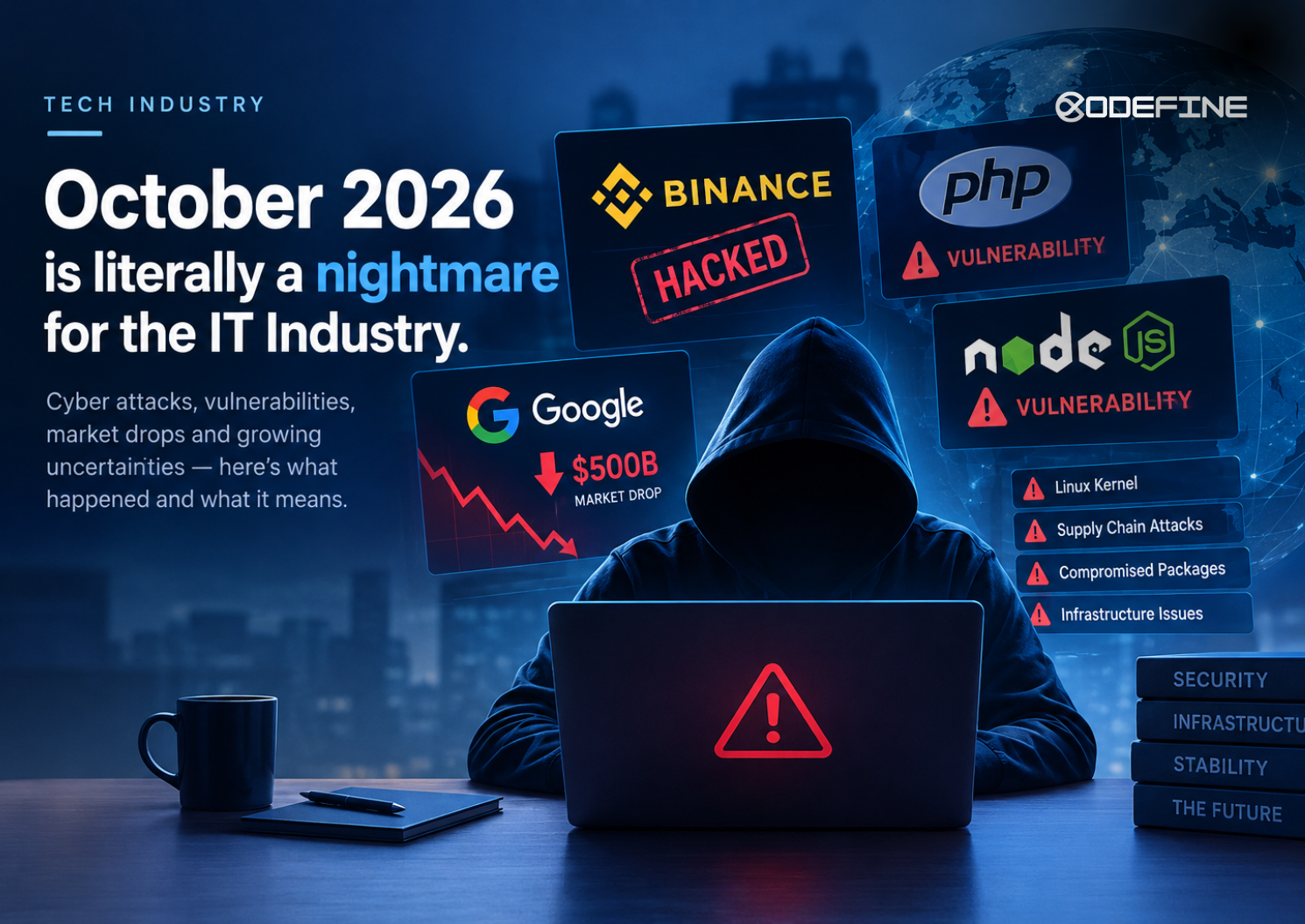
October 2026: A Nightmare for the IT Industry – Cyberattacks, Vulnerabilities and Market Uncertainty
October 2026 is literally turning into a nightmare for the IT industry.
From a massive security incident involving Binance to critical PHP and Node.js vulnerabilities, software infrastructure has faced some serious challenges this month. At the same time, Google's parent company Alphabet experienced a historic stock market decline, raising new questions about AI investments and the future of technology.
The bigger concern is not just how many incidents happened, but how vulnerable our interconnected digital infrastructure can become when security, reliability and proper maintenance are overlooked.
Let's look at some of the major developments and what they mean for businesses and software companies.
1. Binance Security Incident: A Billion-Dollar Wake-Up Call
One of October's biggest cybersecurity stories involved Binance, one of the world's largest cryptocurrency exchanges.
On October 29, a security incident resulted in an estimated $6.3 billion impact. Binance's initial investigation pointed towards a compromised DevOps engineer's laptop, which potentially allowed attackers to access internal infrastructure and initiate unauthorized transactions.
The company reported that approximately $3 billion in affected assets had been frozen and confirmed that it would cover the losses.
This incident highlights an important reality: even large technology companies with significant security resources are not immune to sophisticated attacks.
2. PHP and Node.js Vulnerabilities Raise Concerns
October also brought serious security concerns for developers using popular technologies like PHP and Node.js.
Critical PHP vulnerabilities raised alarms across organizations running PHP-based applications, while a critical Brotli decoder vulnerability (CVE-2026-111497) affected Node.js and other technologies.
The Node.js vulnerability could potentially allow remote code execution or sensitive memory disclosure when applications process specially crafted Brotli-compressed data.
These developments are particularly concerning because PHP and Node.js power thousands of websites, APIs and business applications.
For developers, this is another reminder to regularly update dependencies, monitor security advisories and avoid running outdated software versions.
3. Google Loses Nearly $500 Billion in Market Value
Cybersecurity was not the only concern this month.
On October 29, Alphabet, Google's parent company, experienced a historic 12.6% stock decline, wiping approximately $482–500 billion off its market value.
The decline followed investor concerns about its financial performance and the enormous amount of money being invested in artificial intelligence infrastructure.
This raises an interesting question about the AI industry.
Companies are spending billions on AI models, data centres and computing infrastructure, but investors increasingly want to see how these investments will generate sustainable returns.
AI is transforming the technology industry, but innovation alone does not guarantee profitability.
4. What Should Businesses Learn From These Incidents?
These events may involve global technology companies, but their lessons apply to businesses of every size.
Whether you operate an ecommerce platform, CRM, ERP, customer portal or custom business application, your digital infrastructure needs continuous attention.
Here are a few things businesses should prioritize:
- Security: Protect sensitive information through proper authentication and access controls.
- Regular Updates: Keep frameworks, libraries, dependencies and server environments updated.
- Infrastructure Monitoring: Monitor unusual activities, application errors and potential security threats.
- Data Protection: Maintain reliable backups and recovery procedures.
- Quality Assurance: Test applications properly before and after deployment.
- Long-Term Maintenance: Treat software maintenance as an ongoing responsibility, not a one-time service.
5. The Future of Software Development
For years, the technology industry has focused on building faster, launching sooner and introducing new features.
Artificial intelligence is accelerating this process even further.
However, recent developments show that speed should never come at the cost of security and reliability.
The future of software development will not only depend on who builds the most advanced products, but also on who builds solutions that businesses can trust.
At Codefine Technologies, we believe successful software development requires the right balance of functionality, quality, security and scalability.
Whether it is a custom web application, CRM, ERP or complete business management solution, technology should solve real problems while remaining reliable in the long run.
Final Thoughts
October 2026 has been a reminder that the technology industry is facing challenges on multiple fronts.
Cybersecurity incidents, critical software vulnerabilities, increasing AI infrastructure costs and financial market uncertainty are all shaping the future of technology.
For developers, it is time to take security more seriously.
For business owners, it is time to invest in reliable digital infrastructure.
And for software companies, it is an opportunity to build better, safer and more sustainable solutions.
Innovation moves technology forward, but security and reliability keep it running.